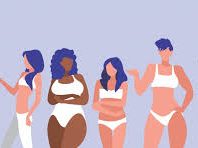
Welcome to our first blog post! We are very excited to investigate and further discuss the issues that shape our culture. As four young women, we experience the obstacles that society imposes on us in our everyday lives. Now, we want to educate ourselves and our classmates on how such obstacles come to be. As a whole, our blog will concentrate on body image in the media and how it relates to gender, race, and sexuality. In this first post, we would like to start with a bit of historical context on “body image”. We will then continue to build upon this concept in future posts.
One of the most dominant ideologies in cultures across the world is that of “ideal beauty”. Ideal beauty, in this case, refers to the highest standard of physical attractiveness. The standard is often difficult to achieve, yet many accept it and even strive towards it. This has been true for many centuries. In the past, people’s perception of how their bodies should look came from their religious beliefs and social status. In more recent history, the standards of beauty began to shift at an unprecedented rate. We find that the introduction of mass media is what exacerbated this process.
Let’s start with what the ideal body was like from the very beginning. The Paleolithic era with The Venus of Willendorf: this is a sculpture that was created in 22,000-24,000 BC and it demonstrates what the ideal body for women was like during that time period. The sculpture was more on the heavy side than curvy, and that is what men looked for at the time. She had large breasts, big hips and a good size belly, which showed that these women were able to bear many children. The sculpture has no face, which indicates that during this time, people did not care about how women’s faces looked, they only cared if their body appeared healthy and strong enough to have many children.
The ancient Greek era: at this time period curvy women were still ideal. They had large breasts, large hips and a slightly chubby stomach. Again, this was still generally seen as women being capable of having children. Unlike the Paleolithic era, however, in the ancient Greek era the face was very important in beauty. Plato said that women were even more beautiful if their faces were symmetrical. This is a concept that we continue to use today, known as the Golden Ratio. This concept of the ideal body continued through the early Renaissance era. However, during this era women were seen less for fertility and more for their lust and sensuality.
Let’s jump to the mid 1800s: The Gibson Girl. Corsets were a huge part of what made women’s bodies desirable and beautiful. The smaller your waist was, the higher your status was. Women would tighten their corsets as tight as they possibly could, regardless of discomfort. This gave the illusion of large breasts, a small waist, rounded shoulders, and a smooth neckline. These features made women appear fragile and put-together. This continued on until the 1920s.
After World War I, women started to become more independent after working and winning the right to vote. With this came the beginning of the flappers. They ditched the corset and started wearing short dresses that allowed them to move, hide their curves and gave the illusion of having small breasts. They also started cutting their hair short. During this time period, gender roles were starting to change and women started caring less about what men wanted them to look like. Unfortunately, the roaring 20s didn’t last long because of The Great Depression. America did not have enough money for extravagant clothes, so women wore whatever they could get their hands on. One big trendsetter in this era was pants. These gave women the appearance of a smaller waist and rounder bum.
During the 1940s, curvy women were back in style, they were called the Curvy Pin-up Girls. One of the most influential women of this time was Marilyn Monroe. She was considered by many to be the most beautiful woman and still is today. Thin women were not attractive to men or to society during this time period. In fact, people in this time would shame skinny women, and the media became important tools for them. Model industries would edit photos and paintings of women’s bodies to give them more intense curves and fuller, pointy breasts. They would release magazines about why curvy women were more beautiful, and some of them offered tips and tricks on how to gain weight in all the right places. Women in this time were more pressured and sexualized and were increasingly seen as sex objects.
Moving into the 70s, 80s, 90s and early 2000s. During the 70s began the era of thin being beautiful. Women still had small curves and full breasts but very thin stomachs were starting to become popular. This is when strong drugs started becoming popular, which increased the rates of skinny women in America. Being thin was very important in the model industry throughout the 80s, 90s and early 2000s. This is when Victoria’s Secret became popular and eating disorders skyrocketed in the U.S. Having a thigh gap and sharp collar bones was seen as beautiful. Kate Moss was a huge influencer during this time period and encouraged women that being skinny meant being beautiful.
It wasn’t until 2010 when there was a lot more diversity. A lot of clothing companies started using more plus size models and social media was huge on how not every woman is the same and everyone’s body is different. However, there still is an ideal body image that many girls still try to achieve and that is having a big butt, small waist, big lips and full breast. Kim Kardashian was one of the main reasons why being curvy came back as a trend. She started wearing corsets for a smaller waist and women now do surgeries to have a big butt and small waist.
The ideal body for women will continue on changing through time. It is amazing how much it’s changed from the beginning of time to now. Many trends come back and new one get added on. Everyone has their own definition of beautiful and what they believe the ideal body should look like. It is important to know that you should not compare your body to someone else’s because everyone is different in their own little way.
https://www.cnn.com/2018/03/07/health/body-image-history-of-beauty-explainer-intl/index.html
Authors: Ashley Lovo, Katherine Castro
 Body Image Through Media
4 replies on “History of Body Image”
Emily Bajek, Katie Sun, and Sanjna Sadarangani:
Beauty standards and gender are especially prevalent now, and the ideals of what constitutes beauty for all genders is being redefined in a new day in age. I enjoyed how this post first reflected the common use of cosmetics for men, and how that connotation has changed throughout the centuries to ultimately alter the meaning of its use. I find it interesting how makeup for men was a way of conveying power and status, and yet as the use of makeup for women became more popular, it became a source of vanity, and a way to please a man, or to feel more attractive for a man. Makeup transformed to fit the unrealistic beauty standards of women, making them feel weak or inferior, which in no way compared to the powerful man’s use of cosmetics in the early 18th century. Although makeup for people of all genders is praised more than ever now, we can still improve our society to lean toward ideologies that associate makeup with positive self-expression, beauty, and virtue, despite standard gender roles and associations.
Advertisements played a huge role in pushing these societal standards of beauty, and it is very damaging for some people to feel like they are lesser than others just because they do not have pale complexions. I like how you also talked about the skin-whitening products industry that continues to persist today, because I feel like a lot of people think that advertisements about skin-whitening are a thing of the past or are unaware of how successful these companies actually are in getting profits. It is so disappointing that advertisers for these companies will push these standards of beauty on people and make them feel insecure so that they can generate profits. I also like how you showed that these old standards of beauty continue to persist today. It is crazy to put into perspective how far back they go, considering that these ideologies are still seen today.
I think it was really important and noteworthy that you mentioned the prevalence of social media and its effect on models. It is true that there are more models with different body types now than there were in previous years, and I think this has a lot to do with the fact that social media has such a huge presence in our lives today. I genuinely hope more and more companies start hiring diverse models because there are still too many that refuse and this is extremely detrimental on little girls and boys who are on social media and are seeing these models everywhere. As time goes on, children begin to join social media at younger and younger ages. I didn’t get Instagram until I was fourteen years old, and my twelve year old sister has already had Instagram for a while. Children are very impressionable at these young ages, and a lack of representation can cause the formation of harmful ideals.
LikeLike
Hi,
I think this a very interesting topic for the first post. Like you mentioned, different forms of media pressure women to strive for this “ideal body image.” It’s interesting to see how that ideal image has shifted over time and a body image that may be unpopular today was ideal a few decades ago. For example, you mention that when the concept of body image first originated in 22,000 B.C, the ideal body was more on the heavier side. However, women are constantly shamed for being overweight in today’s society. Also, in the 1920’s the standard for women was to be petite and fragile. Yet just 20 years later in the 1940’s, women were being shamed for being underweight. The constant shift of the ideal body image just shows how much pressure girls and women are under to constantly strive for whatever is considered ideal at the time. Overall, I think this is a good starting point for your blog. While this posts gives a brief overview of what ideal beauty was in each time period, maybe in later posts can you do more in-depth in one or two specific eras.
LikeLike
Thank you for discussing body image because it is such an important topic, especially today, with the body positivity movement. It is interesting to see how the ideal women’s body has changed over time. As you said, the focus of women’s bodies started with the ability to have children. Then, later in time the face and body become a part of the beauty ideal. You did not give a reason for why this change occurred. I think this happened because, at the beginning of the human race, there was less variation in lifestyle: there were no classes and everyone was a hunter and a gather. As time progressed, there emerged social classes. The upper levels of society had enough food and were able to stay inside all day. Having money allowed them to have an ideal curvy body and them to have a perfectly beautiful face. In the lower classes, everyone had to work and work outside. Working in the sun “ruined” their complexion. Also, they would not have the body idealized at the time because they would not have enough food to have the curves.
As you said, through time, the ideal body keeps changing. As technology increased, then corset changed the perfect body type to be small. The next trend was that women were supposed to be curvier and then small again. I believe that the back and forth of the ideal happens because people want what they do not have. People want to be less curvy, and then when most people obtain that ideal, the ideal changes to curvy.
What I missed from this overview was the idea that beauty ideals, despite the overarching ideal body for society, might differ from the specific groups. Beauty ideals can vary depending on a person’s race, ethnicity, gender, and/or sexuality. I do not know if you are going to discuss body image of people with different identities later on.
In the same vein, I am not sure if you are going to be discussing men when it comes to body image. I think because women have been seen as objects in society and when we talk about body image, we mostly talk about women. I believe it is important to touch upon that, at least in today’s age, men also have body image struggles. How did their ideal bodies change over time? Has it been more stagnant over time? What is its impact?
LikeLike
Hi Ashley and Katherine,
It is very interesting to see how body standards have changed over the many years in human existence. Unfortunately as we know, women have always been judged for their looks and have had certain body standards thrown at them to try and adhere to. From curvy to skinny, one group of women have always been made to feel inferior in some way shape or form in comparison to whatever was the trend at the time. Moreover, I see that beauty standards and overall societal values and norms go hand and hand throughout history. Whatever is valued in society in a particular era influenced what body standard was pushed for women. We see this in periods like the Paleolithic era and the mid 1800’s.In the Paleolithic era fertility was highly valued in society so the ideal for women was based around that. Features like large breasts, big hips, and a big belly supposedly reflected that ability and was highly regarded. In the mid 1800’s features like large breasts, a small waist, and rounded shoulders conveyed that women were fragile. This was a trait that was valued in women then which also impacted the body standards. Furthermore, to me, the fashion industry is a huge culprit in furthering harmful body standards to the masses through things like their marketing and models. However, It is so great to see more diversity coming into the fashion industry in recent years with more and more types of people being accepted. There is still work to be done though as harmful and unrealistic beauty standards still remain. This is in large part due to advancements in communication technologies and media such as the internet, social media, and smartphones. It is ironic because we are in a time where more diversity in coming into the fashion and beauty industry, but in the same vein harmful body images are being furthered with the rise of media technologies. People are only posting and seeing perfected images of themselves and feeling pressure to look like that in real life. As you mentioned celebrities like Kim Kardashian heavily post on social media with things like corsets that artificially contour the body and have been a huge component to the big butt, big lips, and small waist trend. It goes to show that more work needs to be done regarding body positivity and creating a place where people don’t feel the need to constantly compare themselves to others. Again, I really loved reading through your post and it got me thinking about a lot of important concepts regarding body standards.
-Kady McGill
LikeLike